Just random stuff, afforded by an extra ten minutes of battery life.
I am loving life because of:
Acquiring a quality frying pan with lid, thorn resistant bicycle tubes, and packages from home. One package has taken 4 months to get here, but it did come intact!
Tonight is the Premier League championship match! I'm going to watch with a bunch of crazy Brits.
Mangoes.
I promise myself to write a culturally insightful narrative in the next post, but right now, there are mangoes in the Gambia. Going to go eat a mango now.
Ten minutes done...end transmission.
Saturday, May 28, 2011

My head has exploded.
Salaamalekuum!
Let me first say that my head exploding is currently a good thing. I have been in the Kombo area this past week for technical skills training and feel very inspired about the ideas that I can bring back into village. Because I have not been to Kombo for the past two and a half months, and because it has been a long time since my last post, so many things have happened that I know this post will be directionally scattered. I apologize in advance.
Now and for the past month have been a very busy time in the village as farmers work to clear there fields and prepare for the rainy season farming. Fires from field clearing, and the occasional bush fire that results from escaping cinders have been turning the countryside black, patch by patch. The hot wind now has smoke added to the dust as it creates mini tornadoes on the farm fields. Also in Wallalan, people have been working very hard building dry brush fences to enclose their vegetable gardens for the rainy season. I am very excited to see the the bright, growing green color that the rains will enable here. Coming to Kombo, which is right near the ocean, has been a vacation in itself just to see grass and many trees again. The water table here is 3 meters down instead of thirty. ;)
Although it is hard to see progress in the day-to-day, changes have been happening in Wallalan and the Gambia.
My job as a PC volunteer is to build peoples' capacity to help themselves sustain a better standard of living rather than just throwing money at problems, and although I assist this project by finding a $500 dollar resource, I am happy to do it. Water is required for life. Our hand pump project now has to be completed within a month, and I will write up a report describing the finished project.
This week in Kombo has been awesome because of the quality of the hands on training. This week I have put on a bee suit and opened up a top bar hive, processed beeswax and honeycomb, learned how to graft trees, learned about how to make 3 week compost and botanical pesticides, exchanged seeds of agroforestry trees with other volunteers, learned about nursery management...and got to know some really cool people better. What was especially great about this training is that our counterparts from village were also invited to come for part of the training. Buba Jawo (I need to put a picture of him up here), my counterpart from Wallaln, came down to the Kombo and for the first time in our lives, we put on bee suits and opened up multiple hives of 30,000 bees each (with a trainer telling us what to do, of course). This was great because before I had been hesitant to start beekeeping by myself. I had read the PC beekeeping manual, but it seemed like too big of a project for one person to do on paper. Now I have some experience, and a few stings which really aren't that bad, and Buba is also all about this project too. I bought a catcher box from BeeCause, a NGO over here that likes to work with PC, which promotes good ecological beekeeping and our hope is to colonize a hive before the rains come in late June. Time is getting short before the rains!


I have planted some Kola nuts in polypots in my backyard, and i will need to also plant some bitter kola so that i can graft onto a better, drought resisitant rootstock.
I feel so energized right now because I also realize that with beekeeping, I want my second project to be a complete education about all of the uses of the Moringa oleifera tree. Almost all parts of this nitrogen fixing tree are edible and very nutritious, and the use of moringa oil from pressed seeds is nonexistent in the Gambia. The resulting seed cake can be tilled back into the soil or used as animal feed (an excellent selling point of moringa to a herding Fula community). AND moringa is excellent bee fodder. I seriously hope to plant 1000 trees this rainy season and start intensive leaf beds like the one in my backyard with whoever is interested. I am brainstorming with another PC volunteer and we are going to make a seed press together in order to get a good quality oil on a reasonable scale. Moringa oil and moringa leaf powder are untapped markets here in the Gambia, and over in twobobadu (the land of the white people), people pay big money for these products. If people in the US want to try to grow some moringa, I think that is a interesting idea. Since the tree is a crop tree, i don't think it will be ecologically disastrous to plant in America (i hope). Basically the tree likes sun and heat, if you live in an area where it doesn't snow, it'll grow just fine. I'd be happy to mail seeds back.
So this is a tease, i know. I should take more pictures while I am here, and in the next post, I want to basically post a photo album. It is so dang hot here that I shaved my head. Well, actually a boy in my village shaved my head with a straight razor (I watched him shave his father first, so i knew he could do it). Long story short, the wind feels better, I found all of the lumpy spots on my head, and I see the beginnings of male pattern baldness. I look about 8 years older, and nothing like my passport picture. Oh gosh, this is a rushed message. There never seems to be enough time on the internet. Today is my opportunity to tie up as many loose ends before i head back to site tomorrow, and this one is still a little frayed. No matter, more to come. Cheers everyone!
Let me first say that my head exploding is currently a good thing. I have been in the Kombo area this past week for technical skills training and feel very inspired about the ideas that I can bring back into village. Because I have not been to Kombo for the past two and a half months, and because it has been a long time since my last post, so many things have happened that I know this post will be directionally scattered. I apologize in advance.
Now and for the past month have been a very busy time in the village as farmers work to clear there fields and prepare for the rainy season farming. Fires from field clearing, and the occasional bush fire that results from escaping cinders have been turning the countryside black, patch by patch. The hot wind now has smoke added to the dust as it creates mini tornadoes on the farm fields. Also in Wallalan, people have been working very hard building dry brush fences to enclose their vegetable gardens for the rainy season. I am very excited to see the the bright, growing green color that the rains will enable here. Coming to Kombo, which is right near the ocean, has been a vacation in itself just to see grass and many trees again. The water table here is 3 meters down instead of thirty. ;)
Although it is hard to see progress in the day-to-day, changes have been happening in Wallalan and the Gambia.
- Our hand pump has been fixed with loaned parts a few weeks ago so I have had access to clean water again
- My moringa bed in the backyard has been expanded and is ready for it's second harvest! The plant grows faster than a weed, with this crop i will dry the leaves and create a leaf powder that is the equivalent a protein-packed vitamin pill.
- Carlos the cat is bigger! Now that she is larger, I finally got around to looking and Carlos is a female cat. She will remain Carlos though, because she responds to it, and no one over here knows that Carlos is a masculine name.
- My language skills are slowly improving still, and learning work-related vocabulary is fun.
My job as a PC volunteer is to build peoples' capacity to help themselves sustain a better standard of living rather than just throwing money at problems, and although I assist this project by finding a $500 dollar resource, I am happy to do it. Water is required for life. Our hand pump project now has to be completed within a month, and I will write up a report describing the finished project.
This week in Kombo has been awesome because of the quality of the hands on training. This week I have put on a bee suit and opened up a top bar hive, processed beeswax and honeycomb, learned how to graft trees, learned about how to make 3 week compost and botanical pesticides, exchanged seeds of agroforestry trees with other volunteers, learned about nursery management...and got to know some really cool people better. What was especially great about this training is that our counterparts from village were also invited to come for part of the training. Buba Jawo (I need to put a picture of him up here), my counterpart from Wallaln, came down to the Kombo and for the first time in our lives, we put on bee suits and opened up multiple hives of 30,000 bees each (with a trainer telling us what to do, of course). This was great because before I had been hesitant to start beekeeping by myself. I had read the PC beekeeping manual, but it seemed like too big of a project for one person to do on paper. Now I have some experience, and a few stings which really aren't that bad, and Buba is also all about this project too. I bought a catcher box from BeeCause, a NGO over here that likes to work with PC, which promotes good ecological beekeeping and our hope is to colonize a hive before the rains come in late June. Time is getting short before the rains!

I'm in a beesuit!

This was the last picture anyone ever saw of Alpha team as they left to explore the Alien World.
I have planted some Kola nuts in polypots in my backyard, and i will need to also plant some bitter kola so that i can graft onto a better, drought resisitant rootstock.
I feel so energized right now because I also realize that with beekeeping, I want my second project to be a complete education about all of the uses of the Moringa oleifera tree. Almost all parts of this nitrogen fixing tree are edible and very nutritious, and the use of moringa oil from pressed seeds is nonexistent in the Gambia. The resulting seed cake can be tilled back into the soil or used as animal feed (an excellent selling point of moringa to a herding Fula community). AND moringa is excellent bee fodder. I seriously hope to plant 1000 trees this rainy season and start intensive leaf beds like the one in my backyard with whoever is interested. I am brainstorming with another PC volunteer and we are going to make a seed press together in order to get a good quality oil on a reasonable scale. Moringa oil and moringa leaf powder are untapped markets here in the Gambia, and over in twobobadu (the land of the white people), people pay big money for these products. If people in the US want to try to grow some moringa, I think that is a interesting idea. Since the tree is a crop tree, i don't think it will be ecologically disastrous to plant in America (i hope). Basically the tree likes sun and heat, if you live in an area where it doesn't snow, it'll grow just fine. I'd be happy to mail seeds back.
So this is a tease, i know. I should take more pictures while I am here, and in the next post, I want to basically post a photo album. It is so dang hot here that I shaved my head. Well, actually a boy in my village shaved my head with a straight razor (I watched him shave his father first, so i knew he could do it). Long story short, the wind feels better, I found all of the lumpy spots on my head, and I see the beginnings of male pattern baldness. I look about 8 years older, and nothing like my passport picture. Oh gosh, this is a rushed message. There never seems to be enough time on the internet. Today is my opportunity to tie up as many loose ends before i head back to site tomorrow, and this one is still a little frayed. No matter, more to come. Cheers everyone!
Tuesday, April 12, 2011
A normal day is:
I have lived in Wallalan for nearly a month now and my daily schedule has settled into a normal enough pattern. I feel like the first stage of my newbie-toubab grace period is ending as people are expecting me to understand more Pulaar and start some work. I'll always be an outsider though, and that makes me happy because it gives me the freedom to be wildly different from other people as long as it is inoffensive.
So the day.
I get up from my bed between 6:30 and 7:00 because i feel that it is finally light enough to crawl out of bed then. I wake up earlier though, because the morning call to prayer is sung and projected from a loudspeaker just outside my house, and also my 3 day new kitten, Carlos, attacks my hands and feet in play. Carlos is about a 6 weeks old, more on him later. So it is 7 now and I yawn because I always sleep like a brick here. I average about 9 hours a day. As a side note, between all the sleep and the distance required for purchasing alcohol, I get to feel pretty healthy day to day.
When I open my door at around 7:30 I greet my family and the woken people of the compound next to me. The same greetings are used every morning: How is the morning? Did you sleep? Did you sleep without a problem? Did you wake up without a problem? How is your family waking up? The answer to nearly all of these is "Jam tan, Peace only" Greeting takes about 6 minutes. Next I need to haul water for the day. I have a victory, but also a problem in this portion of my day. The victory is that I now own three 20L bidongs to store water. I use this for watering, cooking, washing, and general purpose. Capacity is an amazing thing!

Bidongs. Worth their (empty) weight in gold.
The water problem, now, is that the village hand pump, which was very close to my house, has broken, so for the past week the village hauls water up about 70 feet from an open well. When i go to the well for water, I take my place in the group of women fetching water. Here the well can handle 4 pulleys and 3 people max can work on one pulley. I am the only man in the village that hauls my own water (well I have the help of the two other women on the rope now) and the women, even after a week of getting water from a well, still seem surprised that I am hauling my own water. I like how my hands are getting rougher and more callused. I had felt a little ashamed about my soft hands in the village, and though more callused, they are still the softest of any man, woman, or child.
After water, more people have arisen and more greetings happen. I then go into my house and fix breakfast. I have largely been eating oatmeal or cereal for breakfast with copious amounts of full cream powdered milk and a big cup of tea. When i feel nutrient deprived, I cook a vegetable medley for breakfast and munch through out the day. For this reason, going to town is the best because of the fruit and vegetables there. I am excited to eat bananas today.
Before the day heats up too much I try to get some work done. Sometimes I collect seeds or sow polypots, most of which I have appropriated from tough plastic bags used to hold drinking water, or sometimes I go to chat with the people reclining on the stick platforms in the shade. Most people in the Gambia call this structure a bantaba, but my village literally calls this "the sticks". Other days I clean my house and sit and read while the day is still pleasant. Now i also have the opportunity to play with a cat! Speaking of which, meet Carlos.

Carlos likes to hang out in the Moringa bed in my backyard where it is cool. I worried about the cat damaging the small trees, but then i remember that the local name for that tree here is Never-die. The trees are getting tall and I can harvest the leaves for eating in another month. Carlos eats rice but prefers sardines. Carlos also likes string.
Then, like a wall, the heat comes.
The hours of noon to five are best spent chatting or sleeping. Sweating is continuous in these hours. My host brother's wife, who culturally is also my woman (wife), serves lunch at 1:30-2:00 and lunch itself is steaming hot from the cooking fire. Normal procedure is to take off the lid, take off my shirt, and read a short story while lunch cools.
At five I rouse myself to action for the evening chores. With three bidongs of capacity, I no longer need to go to the pump to fetch more water in the evening. I water my beds and my polypots, and every few days I turn my compost pit. With the watering at home down I walk to the other end of the village to the garden of my village counterpart, Buba Jawo. I have started another Moringa bed for leaf production here and will soon have more beds and a tree nursury for fruit trees and live fencing.
Walking back home my daily chores are done. I bathe and soon afterwards around 8, dinner of lecheri (pounded coos) with some type of oil sauce. I usually eat with my hand, like my family but i must sit on a bidong because I cannot squat to eat with the proficiency of a normal Gambian.
Around 10 i wander back to my home. I listen to music and usually wrestle with the Africell network to send text messages to other volunteers.
Daily, I love the triumphant style in which Sarjo announces the arrival of a meal. "Bubakarr!.....BO-tarri! (lunch)" or "Salifu! (her husband)....HIIR-ande (dinner).
 Sarjo, Abdulai, and Keba, part of my host family.
Now let's meet some characters. On main street (you can see the sticks)
 You can usually find these two men:
 On the right is Demba Bah, who is both the village imaam and the alikalo, the mayor. Demba is one of my biggest helpers in the village even though he does not speak english. He does whatever he can to make me welcome here and I am very thankful for that. On the left, is Ousman Jallow. This man is my favorite person in The Gambia. The Bahs and the Jallows are jokemates, so we constantly insult each other in good humor. Let it be known, here and now, that Ousman Jallow is no good! He eats too much bread! All the bread! And if there is rice, he eats that too. Bahs eat only little, and mostly Lecheri. Bahs work hard. This man is my friend because he can usually be found relaxing on the Bantaba. He has a belly laugh that induces more laughing from everyone. He is constantly sleepy eyed and talks slowly but intelligently. He wears amazing ski hats. He is also a big help in the village for getting things done.
 Ok, I can't resist. Please look at another picture of my cat. I'm living on kitten time right now.
My first mud stove is working! The two week building process (most of it is waiting for the mud to mix or dry) is over and now Sarjo says that the stove DOES cook faster and DOES use less fuelwood. Awesome, I'm stoked, i will begin village outreach about these stoves now.
Ok i am getting scatterbrained, more to come later.
So the day.
I get up from my bed between 6:30 and 7:00 because i feel that it is finally light enough to crawl out of bed then. I wake up earlier though, because the morning call to prayer is sung and projected from a loudspeaker just outside my house, and also my 3 day new kitten, Carlos, attacks my hands and feet in play. Carlos is about a 6 weeks old, more on him later. So it is 7 now and I yawn because I always sleep like a brick here. I average about 9 hours a day. As a side note, between all the sleep and the distance required for purchasing alcohol, I get to feel pretty healthy day to day.
When I open my door at around 7:30 I greet my family and the woken people of the compound next to me. The same greetings are used every morning: How is the morning? Did you sleep? Did you sleep without a problem? Did you wake up without a problem? How is your family waking up? The answer to nearly all of these is "Jam tan, Peace only" Greeting takes about 6 minutes. Next I need to haul water for the day. I have a victory, but also a problem in this portion of my day. The victory is that I now own three 20L bidongs to store water. I use this for watering, cooking, washing, and general purpose. Capacity is an amazing thing!

Bidongs. Worth their (empty) weight in gold.
The water problem, now, is that the village hand pump, which was very close to my house, has broken, so for the past week the village hauls water up about 70 feet from an open well. When i go to the well for water, I take my place in the group of women fetching water. Here the well can handle 4 pulleys and 3 people max can work on one pulley. I am the only man in the village that hauls my own water (well I have the help of the two other women on the rope now) and the women, even after a week of getting water from a well, still seem surprised that I am hauling my own water. I like how my hands are getting rougher and more callused. I had felt a little ashamed about my soft hands in the village, and though more callused, they are still the softest of any man, woman, or child.
After water, more people have arisen and more greetings happen. I then go into my house and fix breakfast. I have largely been eating oatmeal or cereal for breakfast with copious amounts of full cream powdered milk and a big cup of tea. When i feel nutrient deprived, I cook a vegetable medley for breakfast and munch through out the day. For this reason, going to town is the best because of the fruit and vegetables there. I am excited to eat bananas today.
Before the day heats up too much I try to get some work done. Sometimes I collect seeds or sow polypots, most of which I have appropriated from tough plastic bags used to hold drinking water, or sometimes I go to chat with the people reclining on the stick platforms in the shade. Most people in the Gambia call this structure a bantaba, but my village literally calls this "the sticks". Other days I clean my house and sit and read while the day is still pleasant. Now i also have the opportunity to play with a cat! Speaking of which, meet Carlos.

Carlos likes to hang out in the Moringa bed in my backyard where it is cool. I worried about the cat damaging the small trees, but then i remember that the local name for that tree here is Never-die. The trees are getting tall and I can harvest the leaves for eating in another month. Carlos eats rice but prefers sardines. Carlos also likes string.
Then, like a wall, the heat comes.
The hours of noon to five are best spent chatting or sleeping. Sweating is continuous in these hours. My host brother's wife, who culturally is also my woman (wife), serves lunch at 1:30-2:00 and lunch itself is steaming hot from the cooking fire. Normal procedure is to take off the lid, take off my shirt, and read a short story while lunch cools.
At five I rouse myself to action for the evening chores. With three bidongs of capacity, I no longer need to go to the pump to fetch more water in the evening. I water my beds and my polypots, and every few days I turn my compost pit. With the watering at home down I walk to the other end of the village to the garden of my village counterpart, Buba Jawo. I have started another Moringa bed for leaf production here and will soon have more beds and a tree nursury for fruit trees and live fencing.
Walking back home my daily chores are done. I bathe and soon afterwards around 8, dinner of lecheri (pounded coos) with some type of oil sauce. I usually eat with my hand, like my family but i must sit on a bidong because I cannot squat to eat with the proficiency of a normal Gambian.
Around 10 i wander back to my home. I listen to music and usually wrestle with the Africell network to send text messages to other volunteers.
Daily, I love the triumphant style in which Sarjo announces the arrival of a meal. "Bubakarr!.....BO-tarri! (lunch)" or "Salifu! (her husband)....HIIR-ande (dinner).

Now let's meet some characters. On main street (you can see the sticks)


My first mud stove is working! The two week building process (most of it is waiting for the mud to mix or dry) is over and now Sarjo says that the stove DOES cook faster and DOES use less fuelwood. Awesome, I'm stoked, i will begin village outreach about these stoves now.
Ok i am getting scatterbrained, more to come later.
Friday, March 25, 2011
I am a volunteer now!
After the whirlwind of a combined swear-in and All-Volunteer conference in the urban, touristy part of The Gambia, I can proudly declare that I am a card-carrying Peace Corps volunteer (although most days that card stays safe inside my house)! The swear in ceremony took place at the American Ambassador's house, possibly the cushiest backyard I have been in thus far in the Gambia. I mean, with a view like this.....

She gave a speech about her past experience as a Peace Corps Volunteer herself and at the ceremony were other important Gambian officials.
 The graduating Fula Class and teachers of March 2011!
 And the whole group together, everyone looking at a different camera.
I have been living the past 10 days at my site in Wallaland in the Upper Badibou District of the North Bank Region. It is very close to Senegal, in fact I could ride a donkey cart across the border (though i should technically let my Program Manager, Safety and Security Coordinator, etc, etc know of my whereabouts before i do). Wallaland has the most welcoming people, and since they are Fulas, numerous cattle. I am enjoying my time there so far, and although i can get frustrated with not understanding most of what is being said, my language will improve very rapidly in a village with only a handful of english speakers.
In my compound, I have one mother, Jabu. My host brother, Salif , is the head of the compound, and he has one wife, Sarjo, who is about 25 years old. There are 6 children in the compound, the oldest about 10. We are a young family. Unfortuneatly i don't have any pictures of them yet.
I have spent a few of my first days here making my hut into home. This includes the backyard where i have dug a compost pit and also a garden bed for intensive moringa tree leaf production. I will later dig another bed for my other garden veggies. Between the pickaxe, shovel, and water fetching to loosen the soil, I am so proud of my little patch of dirt here. This picture was taken just after I sowed the seeds, so hopefully in a few days they will be sprouting. Thanks to all of the lovely cows, there was plenty of manure to mix in for soil improvement. The soil is very clay-y here.

 The front door to my home!
 Now the goodies: Here is my chariout, my water filter tht sits on top of my wardrobe, my cooking area, and my deluxe red plastic chairs (really quite comfortable).
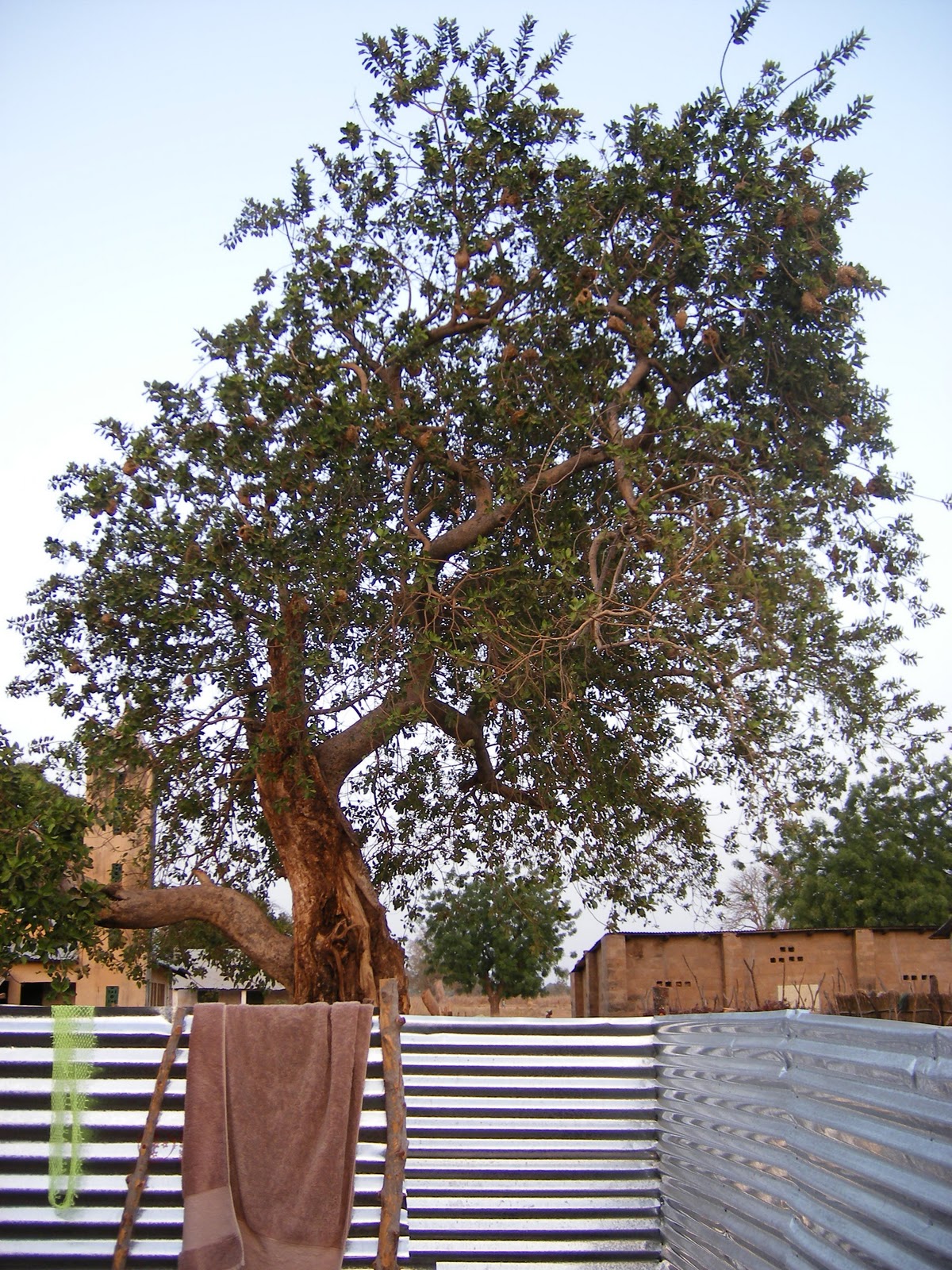
 This awesome tree shades me in the morning. My backyard has the only corrogate fence in the village, so it is pretty easy to guess which house is mine. In the afternoon sun, the corrogate turns into a 4 walled radiator and you need to put on sunscreen if you want to go outside to use the bathroom. No joking. And the real heat hasn't come yet!
There are some quirks that I am noticing everyday about life here. Cell phone culture is interesting, as they are a relatively new thing in the society. It is never considered impolite if your phone starts ringing, whether you are in a meeting, at a naming ceremony, or whatever. That's a changeup for me. Also, ringtones are amusing out here. I particularly enjoy when Gambians, who are largely Muslim, have Christmas carols or other Christian affiliated music as their ringtone. Given, this ringtone is usually accompanied by a techno beat.
It is the start of mango season! Already, kids are pulling unripe mangoes from the trees to gnaw on. Having bought a couple at the market, and waited for a day before i ate the last one, I was struck with a question I can't yet honestly answer. Is a fermented mango better than no mango? Also in season right now are cashew apples , which i enjoy and am thankfully not allergic to.
I will likely have a lot of work opportunity at a community gardn for the village. My counterpart, Buba Jawo, and I have discussed live fencing, tree nursury, gardening, and even bee keeping projects designed to improve villagers lives and create income generation. Thing is though, it really will take village support to pull off any of these projects simply because of the manpower needed to haul water up 60 feet from the garden well. I will hold meetings to find out what the villagers feel their needs are before really begin any serious project work. To be most effective, i need to be able to talk and understand people, so the Pulaar language is my current homework.
I am becoming accquainted with Farafenni, the nearest city, and since i can find my way back to this internet bar now, I can make more posts in the future. Now though, it is lunchtime and my brain is fried. I'm going to go find the chicken sandwiches that this town is famous for, and later go to the market to buy veggies for the next week for me and my family. I got my banking done earlier this morning, so I'm getting in the swing of things. WOOOOOOOOOOOOOOOOOOOOOOOOOOOOOOOOOOOOOOOOOOOOOOOOOOOOOOOOOOOOOOOOOOOOO

She gave a speech about her past experience as a Peace Corps Volunteer herself and at the ceremony were other important Gambian officials.


I have been living the past 10 days at my site in Wallaland in the Upper Badibou District of the North Bank Region. It is very close to Senegal, in fact I could ride a donkey cart across the border (though i should technically let my Program Manager, Safety and Security Coordinator, etc, etc know of my whereabouts before i do). Wallaland has the most welcoming people, and since they are Fulas, numerous cattle. I am enjoying my time there so far, and although i can get frustrated with not understanding most of what is being said, my language will improve very rapidly in a village with only a handful of english speakers.
In my compound, I have one mother, Jabu. My host brother, Salif , is the head of the compound, and he has one wife, Sarjo, who is about 25 years old. There are 6 children in the compound, the oldest about 10. We are a young family. Unfortuneatly i don't have any pictures of them yet.
I have spent a few of my first days here making my hut into home. This includes the backyard where i have dug a compost pit and also a garden bed for intensive moringa tree leaf production. I will later dig another bed for my other garden veggies. Between the pickaxe, shovel, and water fetching to loosen the soil, I am so proud of my little patch of dirt here. This picture was taken just after I sowed the seeds, so hopefully in a few days they will be sprouting. Thanks to all of the lovely cows, there was plenty of manure to mix in for soil improvement. The soil is very clay-y here.


There are some quirks that I am noticing everyday about life here. Cell phone culture is interesting, as they are a relatively new thing in the society. It is never considered impolite if your phone starts ringing, whether you are in a meeting, at a naming ceremony, or whatever. That's a changeup for me. Also, ringtones are amusing out here. I particularly enjoy when Gambians, who are largely Muslim, have Christmas carols or other Christian affiliated music as their ringtone. Given, this ringtone is usually accompanied by a techno beat.
It is the start of mango season! Already, kids are pulling unripe mangoes from the trees to gnaw on. Having bought a couple at the market, and waited for a day before i ate the last one, I was struck with a question I can't yet honestly answer. Is a fermented mango better than no mango? Also in season right now are cashew apples , which i enjoy and am thankfully not allergic to.
I will likely have a lot of work opportunity at a community gardn for the village. My counterpart, Buba Jawo, and I have discussed live fencing, tree nursury, gardening, and even bee keeping projects designed to improve villagers lives and create income generation. Thing is though, it really will take village support to pull off any of these projects simply because of the manpower needed to haul water up 60 feet from the garden well. I will hold meetings to find out what the villagers feel their needs are before really begin any serious project work. To be most effective, i need to be able to talk and understand people, so the Pulaar language is my current homework.
I am becoming accquainted with Farafenni, the nearest city, and since i can find my way back to this internet bar now, I can make more posts in the future. Now though, it is lunchtime and my brain is fried. I'm going to go find the chicken sandwiches that this town is famous for, and later go to the market to buy veggies for the next week for me and my family. I got my banking done earlier this morning, so I'm getting in the swing of things. WOOOOOOOOOOOOOOOOOOOOOOOOOOOOOOOOOOOOOOOOOOOOOOOOOOOOOOOOOOOOOOOOOOOOO
Monday, February 28, 2011


I'm Still Alive!
Greeting from The Smiling Coast Of Africa!
Today I sit and update from the Peace Corps Office in Fajarra, due to my brief stay at the medical center for a spell of "reedu doga" or "running stomach". Either way, I am definetly on the mend and should be released by tomorrow. One benefit of this is that I finally have the ability to climb on the internet for more than 15 minutes and write a post.
During my almost two months in The Gambia, I find that my opinions and feelings about this place change greatly and rapidly from bewildered to frustrated and anywhere in between. I think that this is a result of being new here and jumping in as an alien to a new culture and language. Almost every interaction is so different from American culture it is taking me time just to figure out what people regard as normal and common behavior. This is particularly true in the marketplace where people agressively want you to buy things and haggling is encouraged, in the way that the two genders largely don't have contact with each other in public settings, and in the incredulous stares and flat refusal by many Gambians to sample a peanut butter/banana/chocolate sandwich that I make for a snack. All in all though, I am very excited to be here, and have largely enjoyed my time thus far. Public transportation and roadways are exhilirating and frenetic experiences, and although you need to shove to get a seat on the "gele gele" (the 10-16 person van) people are all very friendly and chatty once the ride has started. I need to shove extra hard to find a seat that my legs fit in.
Here are my vital statistics:
I am called Bubakarr Bah. In my training village, Yuna, I live in a family with 7 brothers and 2 sisters, one of whom i see regularly. My family treats and feeds me very well and are awesome, welcoming people. While my parents don't speak English, the older brothers do and the younger brothers are learning. Bucket baths are delicious, especially when you leave a bidong full of water to heat up in the sun all day. Pit latrines will never break unless they do so much that you fall in (I keep my fingers crossed, mine seems sturdy). I have a gecko that lives in my ceiling and sings to me at night.
 I have been living in the Fula village of Yuna. This is my father, Kali Bah, my mother Raama tu Laahi Camara, and one of my brothers, Sarjo (the child born after twins is always named Sarjo, whether male or female).
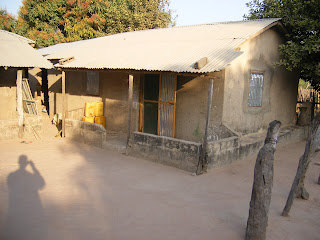
This was my two room house in my family's compound. The big tree behind my house is a mango. Between the two buildings leads to the backyard where the sheep are kept at night (all livestock roams free here during the dry season).
In Yuna I went to school with two other Toubabs (white people) named Stephanie a.k.a. Fatumata Bah and Emily a.k.a. Yiali Bah. I have had two different teachers of Pulaar, the language of the Fula people, while at Yuna, Babacarr Sallah and Ida Keita. They are great teachers for Language and Culture and I feel that I am learning very fast.
Village life is not quiet. Few cars have efficient mufflers, sheep are ornery, people shout greetings at each other from across the town, the mosque loudspeakers announce prayer time 5x a day, the donkeys call to each other at any hour and remind me of the Tuskan Raiders from Star Wars, somebody, somewhere is always drumming, and for the first month a group of boys marched around town at sunup and sundown, drumming and singing to fill their circumcision ceremony tradition.
My pre-service-training is ending and I have already moved out of my training village and said goodbye to my family. I want to post more pictures of them, but blogspot is not cooperating with the computer right now...
Tomorrow I will go to Wallalan, my permanent site for the next two years, for a 3 day visit. I will meet my new family, the imaam, the alkaalo (town mayor) and other village notaries, and get a handle on that village. I then travel back to headquarters for my swearing in ceremony.
There are many things to be written about, but I feel I am in a phase where I am still trying to figure out where things are and why things are the way they are here. I have more pictures, at least, let me try another computer.
Today I sit and update from the Peace Corps Office in Fajarra, due to my brief stay at the medical center for a spell of "reedu doga" or "running stomach". Either way, I am definetly on the mend and should be released by tomorrow. One benefit of this is that I finally have the ability to climb on the internet for more than 15 minutes and write a post.
During my almost two months in The Gambia, I find that my opinions and feelings about this place change greatly and rapidly from bewildered to frustrated and anywhere in between. I think that this is a result of being new here and jumping in as an alien to a new culture and language. Almost every interaction is so different from American culture it is taking me time just to figure out what people regard as normal and common behavior. This is particularly true in the marketplace where people agressively want you to buy things and haggling is encouraged, in the way that the two genders largely don't have contact with each other in public settings, and in the incredulous stares and flat refusal by many Gambians to sample a peanut butter/banana/chocolate sandwich that I make for a snack. All in all though, I am very excited to be here, and have largely enjoyed my time thus far. Public transportation and roadways are exhilirating and frenetic experiences, and although you need to shove to get a seat on the "gele gele" (the 10-16 person van) people are all very friendly and chatty once the ride has started. I need to shove extra hard to find a seat that my legs fit in.
Here are my vital statistics:
I am called Bubakarr Bah. In my training village, Yuna, I live in a family with 7 brothers and 2 sisters, one of whom i see regularly. My family treats and feeds me very well and are awesome, welcoming people. While my parents don't speak English, the older brothers do and the younger brothers are learning. Bucket baths are delicious, especially when you leave a bidong full of water to heat up in the sun all day. Pit latrines will never break unless they do so much that you fall in (I keep my fingers crossed, mine seems sturdy). I have a gecko that lives in my ceiling and sings to me at night.


This was my two room house in my family's compound. The big tree behind my house is a mango. Between the two buildings leads to the backyard where the sheep are kept at night (all livestock roams free here during the dry season).
In Yuna I went to school with two other Toubabs (white people) named Stephanie a.k.a. Fatumata Bah and Emily a.k.a. Yiali Bah. I have had two different teachers of Pulaar, the language of the Fula people, while at Yuna, Babacarr Sallah and Ida Keita. They are great teachers for Language and Culture and I feel that I am learning very fast.
Village life is not quiet. Few cars have efficient mufflers, sheep are ornery, people shout greetings at each other from across the town, the mosque loudspeakers announce prayer time 5x a day, the donkeys call to each other at any hour and remind me of the Tuskan Raiders from Star Wars, somebody, somewhere is always drumming, and for the first month a group of boys marched around town at sunup and sundown, drumming and singing to fill their circumcision ceremony tradition.
My pre-service-training is ending and I have already moved out of my training village and said goodbye to my family. I want to post more pictures of them, but blogspot is not cooperating with the computer right now...
Tomorrow I will go to Wallalan, my permanent site for the next two years, for a 3 day visit. I will meet my new family, the imaam, the alkaalo (town mayor) and other village notaries, and get a handle on that village. I then travel back to headquarters for my swearing in ceremony.
There are many things to be written about, but I feel I am in a phase where I am still trying to figure out where things are and why things are the way they are here. I have more pictures, at least, let me try another computer.
Subscribe to:
Posts (Atom)